



Chinese scientists develop breakthrough ABF crystal, strengthening global lead in VUV technology









A Chinese research team has successfully developed ammonium fluorooxoborate (ABF), a high-performance nonlinear optical crystal designed for vacuum ultraviolet light (VUV) generation. The new material is said to secure China's continued global dominance in VUV optical crystal materials.
All-solid-state VUV lasers, characterized by wavelengths shorter than 200 nanometers, offer advantages such as high photon energy, excellent beam quality, compact structure, superior stability, long lifespan, and low maintenance costs. These attributes make them crucial for advancements in precision machining, laser communication, and frontier science.
Nonlinear optical crystals are the core materials for generating VUV lasers, and their performance directly affects the laser's output wavelength and conversion efficiency, according to Pan Shilie, director of the Xinjiang Technical Institute of Physics and Chemistry of the Chinese Academy of Sciences, who led the research.
China has long been at the forefront of VUV nonlinear optical crystal research. In the 1990s, Chinese scientists invented the potassium beryllium fluoroborate (KBBF) crystal, which has been the only practical crystal capable of achieving laser output below 200 nm through direct frequency doubling for more than three decades.
With the continuous development of laser technology applications, finding a superior crystal with high VUV transparency, strong nonlinear optical response, large birefringence, and excellent growth properties has been a consistent goal in the research field.
Pan's research team innovatively proposed the fluorination design and property regulation mechanism for vacuum ultraviolet nonlinear optical crystals. They incorporated covalent bonds between fluorine and boron, significantly enhancing the crystal's bandgap, frequency doubling effect, and birefringence, elements key to enhancing the crystal's performance.
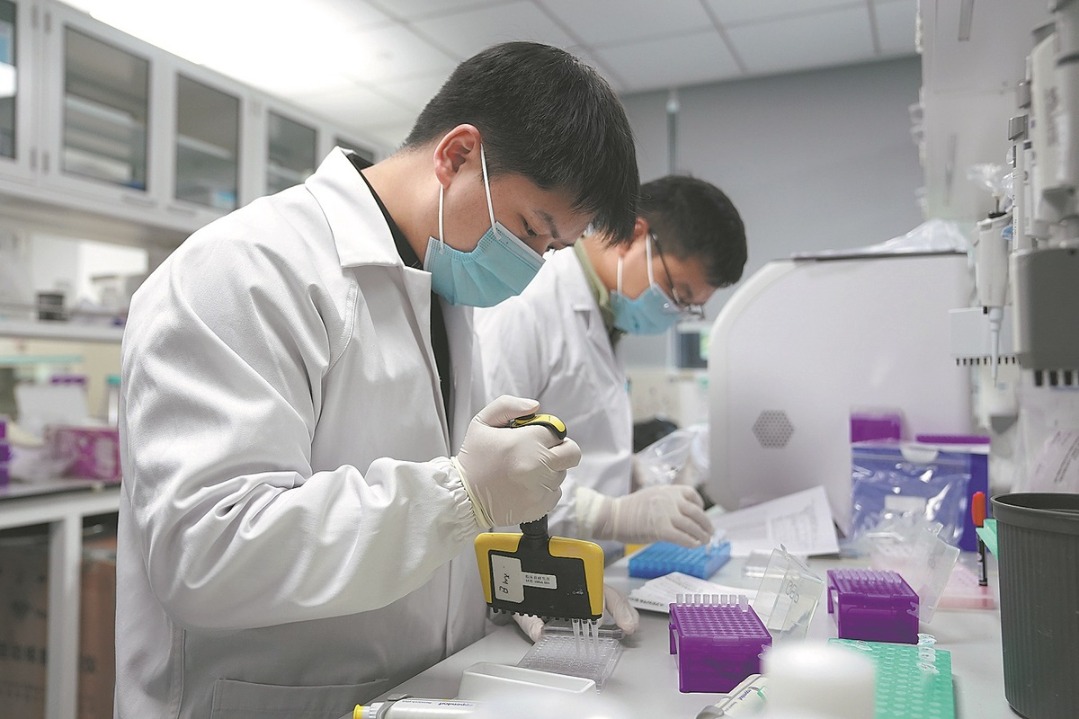
Building on this theoretical innovation, the researchers overcame challenges in crystal growth technology to produce high-optical-quality ABF single crystals with centimeter-scale dimensions.
"Transitioning from millimeter-sized to centimeter-sized crystals was extremely challenging," Pan said. "The team spent nearly 10 years refining the processes and equipment to achieve this breakthrough."
Additionally, the team solved processing challenges related to crystal cutting and polishing and developed VUV nonlinear optical devices with high optical quality and a high laser-induced damage threshold. The research findings were published in the international journal Nature on Thursday.
The ABF crystal's performance is exceptional, achieving a record 158.9-nm light through phase-matching second harmonic generation, a maximum nanosecond pulse energy of 4.8 mJ at 177.3 nm, and a maximum efficiency of 7.9 percent.
"The ABF crystal holds great promise for developing advanced scientific research equipment, exploring superconductivity mechanisms, and venturing into some unknown fields," Pan said. "In manufacturing, it can be applied to ultra-precision microprocessing and high-precision surface treatment in multiple high-end fields, such as aerospace precision equipment, advanced optical manufacturing, precision machinery, and biomedical device production."


- Chinese scientists develop breakthrough ABF crystal, strengthening global lead in VUV technology
- China to boost social assistance for vulnerable groups during Spring Festival holiday
- Scientists develop new crystal, achieving breakthrough in vacuum ultraviolet laser output
- China records markedly warm and wet climate conditions in 2025
- Wanping town, Zhangjiawan, Liangma River redefine Beijing tourism
- He Jiaolong's story included in Xinjiang's government work report