



China's icy regions attract Southeast Asian tourists









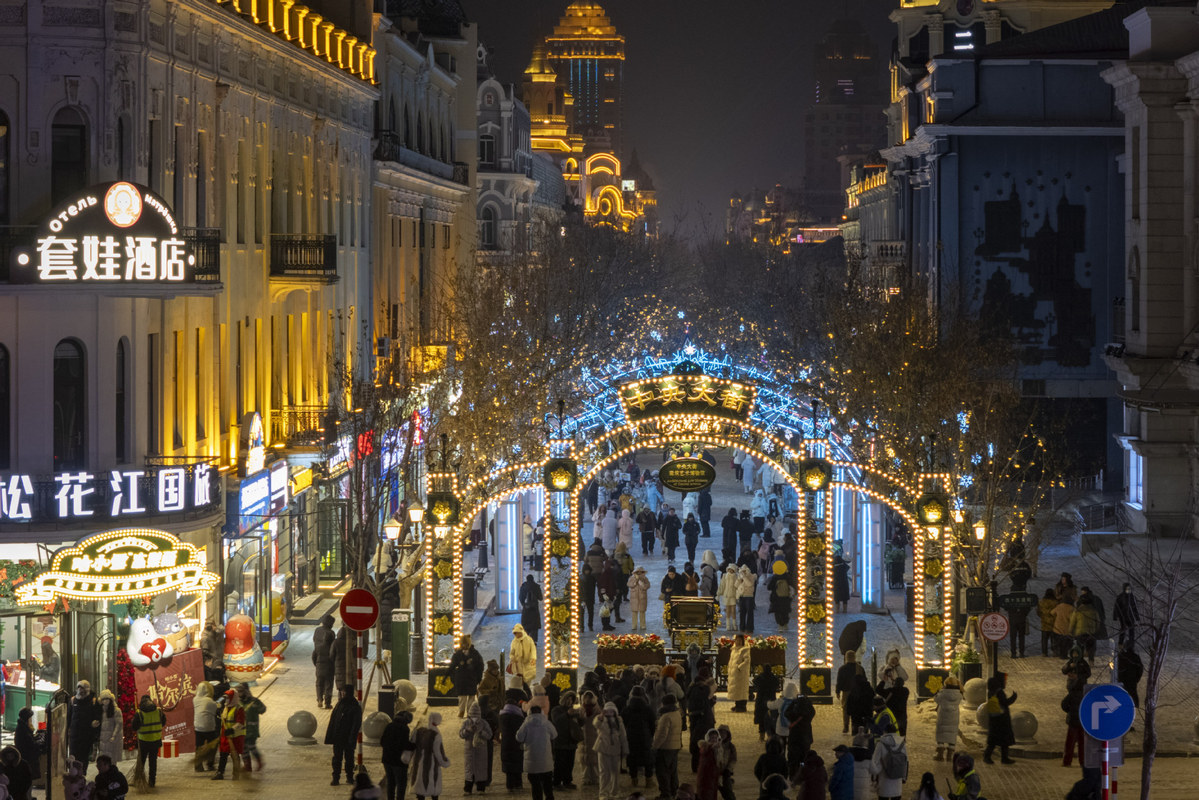
HARBIN — Despite biting temperatures of minus 20 C along the century-old Central Street in Harbin, Northeast China's Heilongjiang province, Thai tourist Nattapong Somchai stamped his feet to keep warm yet happily embraced a local tradition by sampling a classic ice cream bar.
"This is absolutely amazing," he said with unconcealed glee. "There are not only exquisite ice sculptures but also European-style architecture and Western cuisine. The blend of Eastern and Western charm is truly captivating."
Recently, tourists from Southeast Asian countries such as Thailand, Vietnam and Malaysia have been flocking to Harbin, hailed as China's "Ice City", with unprecedented enthusiasm.
Guo Chunguang, general manager of a travel agency in Harbin, said there has been strong demand for direct charter flights from Bangkok to Harbin since the beginning of winter, adding that the agency has already received over 3,000 Thai tourists.
Han Yuanjun, a researcher at the China Tourism Academy, noted that the hot climate and scarcity of ice and snow resources in Southeast Asia are prompting an increasing number of tourists in the region to travel to Northeast China in search of unique experiences.
Since the start of 2026, high-altitude scenic spots across the southwestern Chinese provinces of Yunnan, Sichuan and Guizhou, which boast abundant snowcapped mountains and proximity to Southeast Asia, have also seen a surge in inbound tourists from the region.
On Jan 1 alone, more than 3,000 travelers from Vietnam entered China via Hekou in Yunnan. Many then boarded high-speed trains bound for Jiaozi Snow Mountain in Kunming, the provincial capital, eager to experience snow.
"It rarely snows in Vietnam. With the New Year holiday, many Vietnamese are eager to see snow in China," Vietnamese tour guide Nong Thuy Duong said.
According to a report released last year by China's General Administration of Sport, the country's ice-and-snow economy has experienced significant growth in recent years. The sector's scale expanded from 364.7 billion yuan ($52.4 billion) in 2016 to 980 billion yuan in 2024, with an average annual growth rate exceeding 21 percent.
Through four consecutive years of overseas promotional campaigns for ice and snow tourism, China has expanded its international market presence and achieved targeted outreach for its winter tourism brand in Malaysia and Vietnam. Data shows that there has been a significant increase in Southeast Asian tourists visiting ice and snow destinations in Harbin, Jilin, another province in Northeast China, and Sichuan.
According to Tang Chengcai, professor at Beijing International Studies University's School of Tourism Sciences, this growth is no longer a mere increase in visitor numbers but reflects the deep integration of China's ice and snow industry chain with the global tourism consumption market. It has fostered a new international ecosystem that spans product development, cultural exchanges and service trade, Tang added.
China's optimized visa-free transit policies have also reduced travel barriers for Southeast Asian visitors. "It used to be expensive to get a visa, but now it's so easy. You can just buy a ticket and travel around China. The visa-free policy is really a great move," said Yanti, a tourist from Singapore.
Industry insiders point to a prominent trend as Southeast Asian tourists in China move beyond ice and snow tourism to seek deeper cultural experiences, with "living like a local" growing in popularity.
At Harbin's Zhaolin Park, home to a six-decade-old ice lantern garden party, Thai tourist Siriporn Wannarat took photos with her child in front of ice sculptures and wandered through an ice maze. "What moved me the most is that the park is open for free here. We can take a walk after dinner and feel the pulse of the city. That's what real life is about," she said.
Han said Southeast Asian tourists have a strong interest in Chinese culture, and they are naturally drawn to the unique local customs, winter fishing and ice sculpture art in Northeast China.
Pan Jie, a Harbin-based tour guide, has also observed that Thai tourists' itineraries are expanding beyond the city to include Yabuli's professional ski resorts, the snow-blanketed forests of Snow Town, and folk-tradition villages across Northeast China.
The influx of Southeast Asian visitors is setting higher standards for the internationalization of China's ice and snow industry. Local authorities in the country are rolling out targeted service upgrades.
The Harbin Taiping International Airport has seen four new international routes to Ho Chi Minh City, Hanoi, Bangkok and Kuala Lumpur, increasing its weekly number of passenger flights from 87 to 118.
Ports such as Heihe and Suifenhe in Heilongjiang have implemented measures like deploying bilingual police officers for guidance and dynamically adjusting inspection lanes to ensure efficient clearance for travelers.
According to statistics from the Heilongjiang provincial exit and entry frontier inspection station, from Jan 1 to 13, the number of inbound and outbound passengers at ports in the province reached 122,000, marking a 37 percent increase compared to the same period last year.
"I really like Snow Town. It's so beautiful here, and I enjoy experiencing the feeling of cold here," said a Vietnamese tourist visiting Heilongjiang for the first time, adding that the English translations in the scenic area and the helpful local people made him feel at ease.





- China's icy regions attract Southeast Asian tourists
- Century-old TCM pharmacy pivots to become fashionable wellness brand
- Agri sector reaps fruit of tech advances
- Central government appoints new foreign ministry commissioner in Macao SAR
- Winter camp solidifies cross-Strait youth ties
- Old architectural marvel in Beijing back in public view