


Key events define Sino-EU ties in 2025









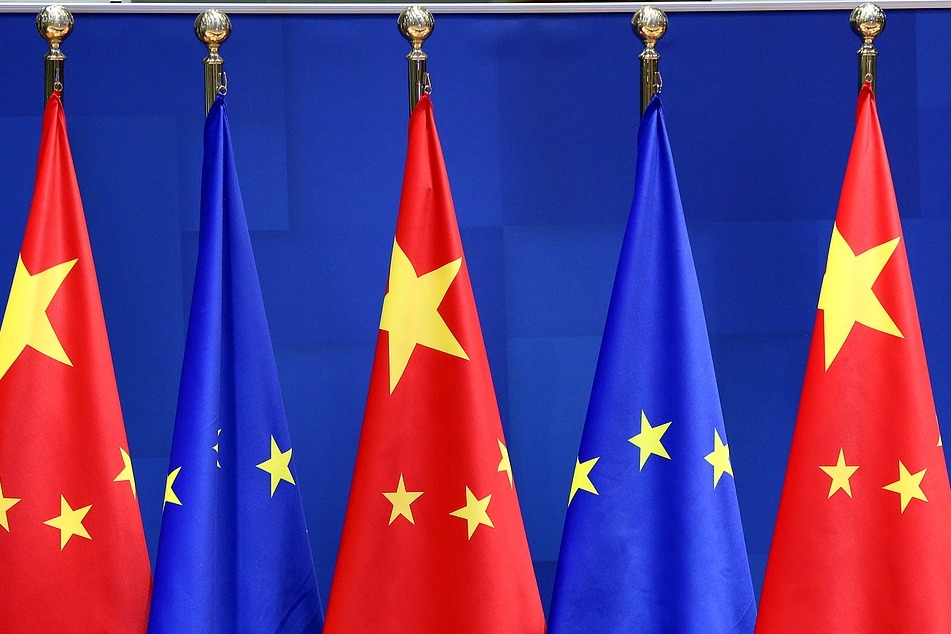
The year 2025 marks the 50th anniversary of China and the European Union establishing diplomatic relations. Over the past half-century, the China-EU relations have evolved through dialogue, cooperation and occasional challenges, shaping one of the world's most important bilateral partnerships. Key events have defined China-EU relations in 2025, with experts calling on both sides to addressing each other's concerns through dialogue and cooperation amid geopolitical challenges.
1. China-EU 50th Anniversary and 25th Summit
On May 6, 2025, President Xi Jinping exchanged congratulatory messages with President of the European Council Antonio Costa and President of the European Commission Ursula von der Leyen to warmly celebrate the 50th anniversary of the establishment of diplomatic relations between the two sides.
On July 24, the two sides held their 25th summit in Beijing, in which President Xi met with Costa and von der Leyen. The summit provided an opportunity for leaders to review the bilateral relationship in all its dimensions, while also addressing global and geopolitical challenges. The milestone anniversary added significance to the summit as both sides assessed how to steer their ties amid shifting global dynamics.
During the meetings, President Xi said China-EU relations had arrived at "another critical juncture", calling on leaders from both sides to demonstrate renewed vision and provide the world with greater stability and predictability through sound, steady relations. For the future development of China-EU relations, Xi made three proposals: the two sides should uphold mutual respect and consolidate the positioning of China-EU relations as a partnership; uphold openness and cooperation, and properly manage differences; and practice multilateralism and uphold international rules and order.
Li Xing, director of the European Research Center at Guangdong University of Foreign Studies and an adjunct professor of international relations at Aalborg University, Denmark, said that the China-EU Summit offered both sides an opportunity to reaffirm their long-standing partnership. The summit signaled a shared commitment to maintaining engagement amid complex global circumstances.
While challenges such as the Ukraine conflict, trade imbalances, and the EU's internal structural contradictions continue to shape the context, China's strong role in global supply chains and renewable energy technologies also create opportunities for cooperation.
2. China prolonging visa-free policy for multiple EU member states
China has further broadened its visa-free access for European travelers in 2025, extending a major unilateral exemption policy well into 2026.
On Nov 3, 2025, China announced that the visa-free arrangement for more than 30 European countries, first expanded in 2023 and 2024, will be prolonged until Dec 31, 2026. During this period, holders of ordinary passports from these countries may enter China without a visa for business, tourism, family visits, exchanges, or transit, for stays of up to 30 days.
So far, 34 European countries have been included in China's unilateral visa-free program, marking one of the country's most extensive efforts to facilitate cross-border travel and boost people-to-people exchanges.
Men Jing, director of the European Research Center at East China Normal University, said that China's visa-free policy for multiple EU member states directly strengthens people-to-people connectivity, which has long been one of the stabilizing pillars of the relationship. Reducing entry barriers allows European academics, students, business people and tourists to re-engage with China firsthand, further revitalizing commercial exchanges. Even in an era of "de-risking", the EU still needs stable channels for commercial interaction with China.
3. Bilateral trade remains stable and sees growth
Although China-EU trade data for the full year of 2025 has not yet been released, figures from the first half of the year, along with other available indicators, suggest that bilateral trade is on track to grow. According to official data in June, the EU remained China's second-largest trading partner in the first 11 months of 2025, with total trade reaching $749.34 billion, a 4.6 percent year-on-year increase and accounting for 12.8 percent of China's total foreign trade.
Looking at the year as a whole, China and the EU have broadly maintained the scale of their bilateral trade, and the two sides remain among each other's most important trading partners. China continues to be the EU's largest source of imports.
Notably, several innovative Chinese companies have been expanding their presence in Europe. Battery manufacturer CATL has increased investment in Hungary, and automaker BYD is planning further investment in Spain. These moves are echoed by European enterprises such as Volkswagen, which is setting up a joint R&D center in Hefei, Anhui province.
Ding Chun, director of the Center for European Studies at Fudan University, said that on the one hand, rising two-way investment and steadily growing bilateral trade demonstrate the strong resilience of China-EU economic cooperation and reflect a broad attitude of both competition and collaboration. On the other hand, the impact of geopolitics on economic relations has also become evident, as Europe has repeatedly accused China of alleged "subsidies" to its companies, and the investment conditions for Chinese firms in Europe have been tightened.
Looking ahead, the economic and trade links between China and the EU will remain close and cannot easily be "decoupled". Europe faces mounting economic pressures both internally and externally, while China is working to achieve the goals outlined in its newly adopted suggestions for the 15th Five-Year Plan, securing enough room to improve China-EU economic relations.
4. China and Europe collaborate amid sharp rises in the US tariffs
In early 2025, the US administration imposed unilateral high tariffs on major economies worldwide. Both China and the European Union are at the receiving end, and the US itself bears the disruptive impact.
Both China and the EU have engaged in negotiations with the US over the tariff issue, and public opinions in China and Europe have been remarkably aligned, overwhelmingly opposing the United States' high tariffs. The fact that three rounds of China–US talks were held in Europe, namely in London, Stockholm and Madrid, is itself a clear reflection of Europe's position.
Dai Yichen, director of the Institute of European Studies at the Institute of International Relations, Shanghai Academy of Social Sciences, said that US tariff pressure has further complicated the existing trade frictions between China and the EU, yet both sides still have a strong political will to address each other's concerns through dialogue.
5. French President paid a state visit to China
French President Emmanuel Macron paid his fourth state visit to China from Dec 3 to 5, which also reciprocated the state visit to France by President Xi Jinping in 2024 on the occasion of the 60th anniversary of China-France diplomatic relations.
During Macron's visit, the two countries issued joint statements on strengthening global governance, a joint response to global climate and environmental challenges, continuous promotion of cooperation in peaceful use of nuclear energy, exchanges and cooperation in agriculture and food, and the situations in Ukraine and Palestine.
Zhao Yongsheng, director of the French Economic Studies Center at the University of International Business and Economics, said that Macron's visit to China can be described as a diplomatic success on three fronts. First, acting on behalf of France and French businesses, he secured substantial commercial agreements with China, giving fresh momentum to bilateral economic cooperation. Second, in his capacity as a leading voice within the European Union, he sought to stabilize China-EU relations and contribute to broader mediation efforts on the Ukraine crisis. Third, his trip further deepened cultural and educational exchanges, reinforcing the humanistic foundations of the bilateral relationship.
6. The Spanish King paid a state visit to China
From Nov 10 to 13, King Felipe VI of Spain and his wife Queen Letizia paid a state visit to China, the first by a Spanish king in 18 years.
On Nov 12, President Xi Jinping met with the King at the Great Hall of the People in Beijing. Xi noted that both China and Spain have profound historical and cultural heritage. As the two countries celebrate the 20th anniversary of the comprehensive strategic partnership, King Felipe VI's state visit is of great significance to advancing the friendship and cooperation between the two countries.
Yan Xiaoxiao, a research fellow at the Institute of International Relations at the Shanghai Academy of Social Sciences, said that King Felipe VI's visit to China underscores Spain's consistent approach of viewing relations with China from a strategic perspective and pursuing a pragmatic, cooperation-focused China policy centered on economic engagement. The visit also demonstrates that EU member states such as Spain are willing to resist pressure from the United States and uphold Europe's strategic autonomy. This, in turn, carries significance for encouraging the European Union to adopt a more positive and constructive policy toward China.
7. China-Germany relationship insists on win-win cooperation
On Nov 23, Premier Li Qiang met with German Chancellor Friedrich Merz?in Johannesburg. Li said that since the establishment of diplomatic relations between China and Germany (then West Germany) in 1972, the two sides have continuously strengthened dialogue and cooperation, effectively promoting the common development of both countries.
Merz?said that Germany?and China?have long been important economic and trade partners, with highly complementary economies. Germany attaches importance to developing?relations with China and believes that China's 15th Five-Year Plan (2026-30) will create opportunities for both Germany and the EU.
Zheng Chunrong, director of the German Studies Center at Tongji University, said that China-Germany relations are now at a pivotal moment. The year 2025 marks both the 50th anniversary of China-EU diplomatic ties and the 10th anniversary of the China-Germany comprehensive strategic partnership. The trajectory of China-Germany relations is, therefore, closely intertwined with the broader dynamics of China-EU relations.
In the first three quarters of this year, bilateral trade once again surpassed Germany-US trade, making China Germany's largest global trading partner. However, to consolidate and deepen cooperation, both countries must identify and cultivate new areas of joint growth.
8. EU-China high-level environment and climate dialogue held
On June 14, the 4th EU-China high-level environment and climate dialogue was held in Beijing.
The two sides discussed their respective domestic climate, energy and environmental policies, as well as bilateral cooperation and multilateral negotiations, and reconfirmed that the dialogue is an important platform for the exchange of views and cooperation, and for advancing implementation and ambition.
Qin Yan, a principal analyst at Norway-based ClearBlue Markets, said that amid complex trade tensions, the dialogue proves that the green partnership remains a most resilient bridge between Brussels and Beijing.
It also stands out as a resounding victory for global climate governance. In a year often defined by fragmentation, this event was a beacon of shared climate ambition. The joint commitment to accelerating the circular economy and locking in aggressive renewable goals ahead of COP30 was a masterclass in bilateral leadership.
9. China and the EU ensure stable supply chain
In late 2025, after a period of export-control tensions, the EU and China worked out a new "special channel" to ensure a stable supply of rare earths and critical raw materials to European industry, which is vital for sectors such as EVs, battery production, green technologies and electronics.
The move follows China's export controls on rare earths, which raised concerns in Europe after their introduction earlier this year over potential disruptions to the production of electric vehicles, wind turbines and other technologies that depend on permanent magnets.
Chinese authorities agreed to suspend the expansion of restrictive export controls for at least a year and to prioritize export license applications from European firms.
Jian Junbo, director of the Center for China-Europe Relations at Fudan University, said that the rare earth issue is a typical example of mutual dependence between China and the EU. If the European Union approaches its economic and trade relations with China purely through the lens of geopolitical rivalry and "de-risking" industrial chains, it will inevitably prompt China to respond from its own security and geopolitical considerations.
If Europe, or the wider West, truly wishes to restore a healthy global economic system, it must return to an open, fair and multilateral framework rather than impose a security-driven or geopolitically oriented one.
10. Nexperia case sees hope of being solved
Claiming that Nexperia, a semiconductor company owned by Chinese company Wingtech Technology, had "serious governance shortcomings" that posed a threat to crucial technological knowledge and capabilities, and economic security, the Netherlands government announced on Sept 30 it would take control of Nexperia for one year, with a court order that followed one week later.
Under pressure from both public opinion and the Chinese Ministry of Commerce, and as a result of talks among China, the EU and the Netherlands, the country's economic minister, Vincent Karremans, announced in November that he was suspending his administrative order on Nexperia, but the court order is yet to be overturned.
On Jan 14, the Dutch Enterprise Chamber held a hearing on whether there were valid reasons to doubt the sound policy and conduct of business at Nexperia and whether there were grounds for the Enterprise Chamber to order an investigation into it. The court didn't issue a verdict on site.
Lai Suetyi, Associate Professor and Jean Monnet Chair at the Center for European Studies at Guangdong University of Foreign Studies, said that the European Union showed caution to avoid being further dragged into the China-US trade and tech conflict. Negotiations between the Chinese and Dutch authorities since November have thus far resulted in a suspension of the seizure, yet the court ruling remains in force. The Chinese side demands a revocation of the executive order and withdrawal of the court ruling. A full stop to this saga would signal a return to the Netherlands' pragmatic approach to its China policy, which would be welcomed by Beijing.
zhangzhouxiang@chinadaily.com.cn