


Ultimatums erode trust, efficiency of world economy









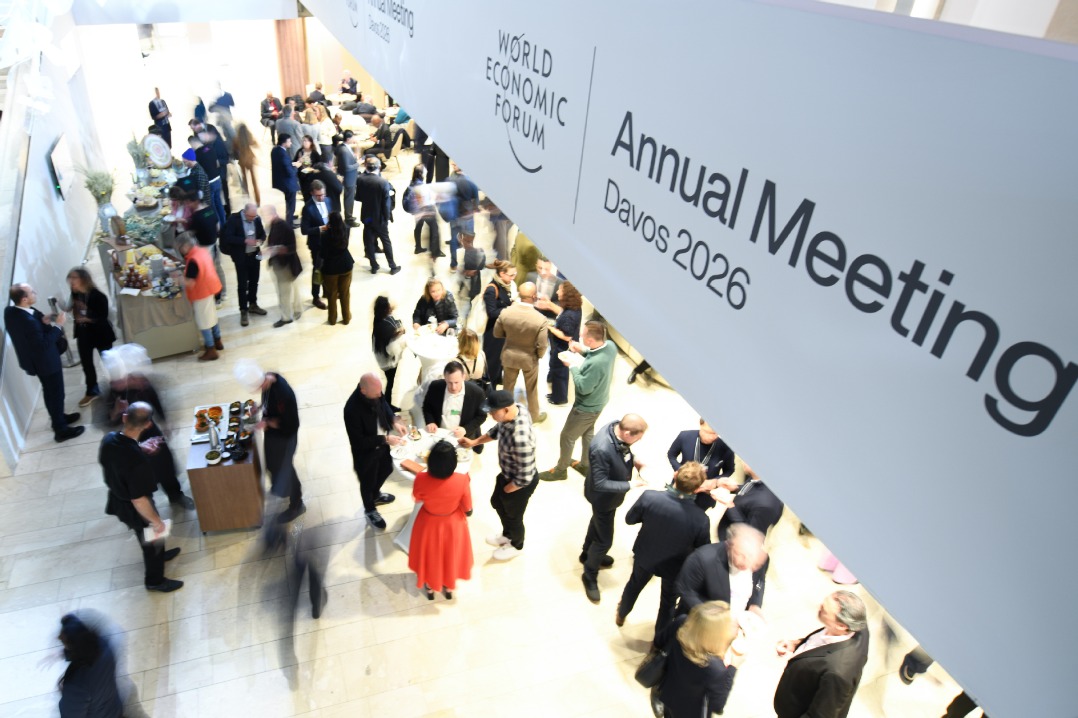
The annual Davos gathering of political leaders and corporate chiefs in the Swiss Alps is often treated as a barometer of the global mood. Sometimes it reflects optimism about growth, while at other times it reveals unease about wars, debt, inflation or technology shocks.
Yet one anxiety has become unusually visible at this year's World Economic Forum meeting in Davos: the sense that trade, finance and market access are no longer governed primarily by predictable rules, but by threats, and that economic coercion is being normalized as a substitute for diplomacy.
The current transatlantic dispute over Greenland illustrates the shift. When tariff threats are publicly linked to a demand over territory (a demand rejected by Denmark and Greenland), the dispute is no longer a conventional negotiation about trade balances, regulatory alignment or even security burden-sharing. It becomes a test of whether coercion can rewrite political red lines.
Media reports on the episode have captured both the bluntness of the United States' posture and the seriousness with which Europe is weighing retaliation, including a debate over the European Union's Anti-Coercion Instrument, a legal framework created to respond to economic intimidation.
In Europe, the dilemma is structural. Retaliation can protect credibility but risks escalation that harms European companies and consumers. Restraint can lower immediate costs, but it risks inviting more pressure later.
Markets, in turn, do what they always do when confronted with uncertainty: they price the risk.
Reuters has noted that tariff threats have already jolted currencies and equities, a reminder that "policy-by-ultimatum" becomes a tax on confidence long before any tariff takes effect.
The broader question is whether sanctions and tariffs still work as policymakers promise. The honest answer is that they do work, but often unevenly, with consequences that are poorly distributed and frequently strategic rather than purely economic. The world is now better at adapting to pressure than it was a decade ago. Supply chains reroute; intermediaries multiply; substitution accelerates; and "friendshoring" creates new winners and losers. The targeted economy may suffer, but it also adapts. It diversifies. It builds alternatives. And the sender's leverage erodes over time, even as collateral costs to bystanders accumulate.
That is why the major multilateral institutions are increasingly alarmed by geo-economic fragmentation. The International Monetary Fund's latest World Economic Outlook update, for example, projects global growth at 3.3 percent in2026, but it explicitly emphasizes how policy shifts and uncertainty shape outcomes, a diplomatic way of describing the costs of confrontation and unpredictability. The World Bank's Global Economic Prospects report, meanwhile, acknowledges resilience but flags rising trade barriers and policy uncertainty as key downside risks to global growth.
The international institutions are making a point that is easy to miss amid political drama: the global economy can continue to grow while becoming less efficient, less stable and more unequal. Fragmentation is not a single "crash"; it is a slow accumulation of friction, higher financing costs, duplicated production networks, delayed investment and a persistent premium on safety over efficiency. That premium is disproportionately paid by developing countries and smaller economies, which have less bargaining power and fewer alternatives when access to markets or technology becomes conditional.
Coercion may look decisive in domestic politics, but it is corrosive internationally because it teaches every partner the same lesson — that dependence is dangerous. Once that lesson sinks in, the rational response is to reduce exposure, and the cumulative result is a world economy that is less integrated, less efficient and more prone to crisis. The world can live with competition. What it cannot afford is a permanent global economy run by ultimatum.
Coercion will not disappear, but it can be made expensive, awkward and ultimately self-defeating. The answer is collective discipline that turns intimidation into a bad bet, calibrated retaliation, enforceable anti-coercion rules, diversified supply chains and payment rails, and a revived respect for multilateral bargaining over unilateral brinkmanship.
The world can absorb rivalry, but it cannot normalize ransom. If economic statecraft becomes a permanent threat to the economy, every port, pipeline and platform will be built with suspicion baked in, and growth will arrive more slowly, and will be costlier and meaner.
The deeper issue is legitimacy. In the end, an empire of ultimatum discovers the same truth: You can scare partners into compliance for a season, but you cannot bully your way into legitimacy.
The author is an Indian scholar in the Department of Journalism of Hong Kong Baptist University in Hong Kong.
The views do not necessarily reflect those of China Daily.