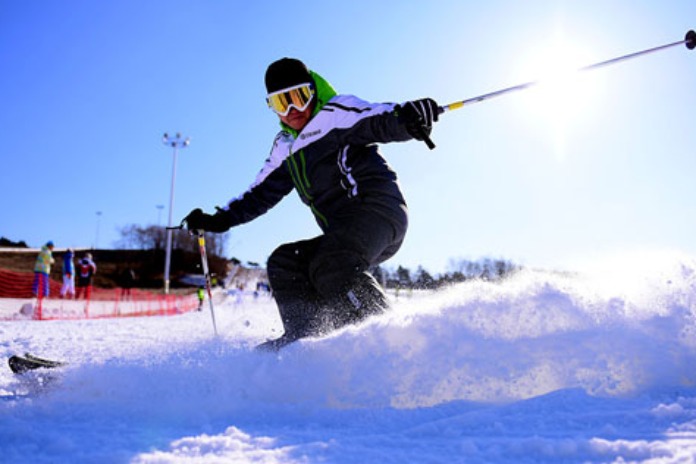



For para skiers, just making the start line is a victory in itself










A motto that captures the essence of the Paralympic spirit resonates deeply across the venues of the 2026 Milano-Cortina Winter Paralympic Games every day — just showing up is, itself, a victory.
For spectators, the power of this spirit is perhaps most palpable at the Tofane Alpine Skiing Centre in Cortina. There, athletes hurl themselves down a 2.5-kilometer-long track carved into the mountainside, featuring a vertical drop of about 750 meters.
Skiers typically reach their maximum speed — up to about 130 kilometers per hour — after navigating a steep wall with a gradient of about 64 percent.
They then take on a series of curves, drops and gates that challenge their agility and control.
"Simply reaching the starting point requires four cable car rides and three ski runs," said Wang Jingping, coach of the Chinese para alpine skiing team.
"From the very first day of training here, we realized that this is an incredibly steep and challenging course, especially the starting section," he said. "The most important thing is to overcome fear, execute techniques properly and complete the race to the best of our ability."
Para skier Liu Sitong described the course as one of the most difficult she has ever encountered, noting that she rarely sees comparable conditions at domestic ski venues.
"For me, the hardest part is racing through a number of rolls and bumps that launch us into the air," said the 31-year-old.
"Also, I must carefully choose my route and make precise turns to avoid missing any gate.
"The charm of alpine skiing lies in its unpredictability. Even for the most decorated athletes, with the best skill sets, a slight mishap or a 0.01-second gap could cost a spot on the podium."
Alpine skiing at the Paralympics features five disciplines, each testing the balance of speed and technique. Liu competes in the sitting class and takes part in all five events. As of Wednesday, she has earned three bronze medals in the downhill, super-G and alpine combined.
In super-G events, skiers are not allowed a trial run and instead receive 90 minutes to inspect the course before the actual race. During Monday's six medal events in super-G, a number of athletes were seen leaving the course or crashing into poles midway down the slopes.
"It is certainly heartbreaking to see fellow athletes unable to finish the race and even hurt themselves," Liu said. "But deep down, we know that the primary goal here is to demonstrate an indomitable and courageous spirit, regardless of whether or not we end up on the podium."
"Alpine skiing is a sport for the brave," she said. "Standing on the starting line at the Games is already a victory in itself."
Liu made her Paralympic debut at Pyeongchang 2018 as the nation's first ever para alpine skier, and she now considers herself a veteran on the team. She expressed her delight at the growing popularity of alpine skiing among the public.
On Monday, roars rang down the grandstand at the Tofane Alpine Skiing Centre as spectators cheered for every athlete, regardless of their nationality or race results.
"I can feel their enthusiasm for the sport," Liu said. "Their support also motivates me to keep pushing myself and never give up."
- China wins first Paralympic gold in wheelchair curling mixed doubles
- A guide to winning: Para skiers' partners plot a course to success
- China extends Winter Paralympics medal lead on 4th competition day
- Wu 'outdoes himself' to bring home snowboard cross gold
- Chinese Paralympic skier Liu Sitong wins second bronze as China leads medal table


Most Popular
- F1 Chinese Grand Prix returns with major upgrades
- China dominates Winter Paralympics with 6 golds, leads medal tally
- Milan-Cortina Winter Paralympics opens at Verona Arena
- Nation's Winter Paralympics squad is its biggest ever
- China to send 70 athletes to Milan-Cortina Paralympic Winter Games
- China announces largest-ever delegation for 2026 Winter Paralympics in Italy