


Program continues the beautiful vitality of verse
With short-form content all the rage, television competition highlights the deep impression poetry leaves behind, and how it can even boost cultural tourism, Li Yingxue reports.









This year, 18-year-old Song Hongri, a Beijing freshman at the University of Hong Kong, returns to the show, Chinese Poetry Conference, for the third time. He first appeared on the program seven years ago as a pupil from Peking University Elementary School, and he returned two years later as his bond with classical poetry deepened.
"Coming back for the third time feels familiar and warm," Song says."What was once simply an interest has become a love for poetry that I hope to turn into a career path."
Sharing the stage with him was another familiar face: Sun Xiaojing, a postdoctoral researcher in space environment studies at Beihang University. Like Song, Sun first appeared in the program seven years ago as a poetry enthusiast.
Since then, she has completed her doctorate and contributed to major national aerospace projects, researching spacecraft and the space environment.
Now in its 10th season on China Central Television, Chinese Poetry Conference hosts poetry lovers aged 6 to 90 from all walks of life, turning verse refined over millennia into an emotional bond that transcends age, profession, and background.
After a decade on air, the program has evolved beyond a test of poetry knowledge. By blending competition with shared cultural appreciation, it has consistently ignited nationwide interest in classical poetry, bringing ancient literature into the contemporary public sphere.
Beyond recitation, the show reactivates the historical, geographical, and cultural worlds behind the verses, deepening the connection between tradition and modern life. Its influence now extends into cultural tourism, transforming poetry from static text into a participatory public experience.
In an era dominated by fragmented reading, why do people still slow down and immerse themselves in poetry? The answer may lie within the contestants. For participants, poetry represents a spiritual pursuit beyond the demands of work and study.
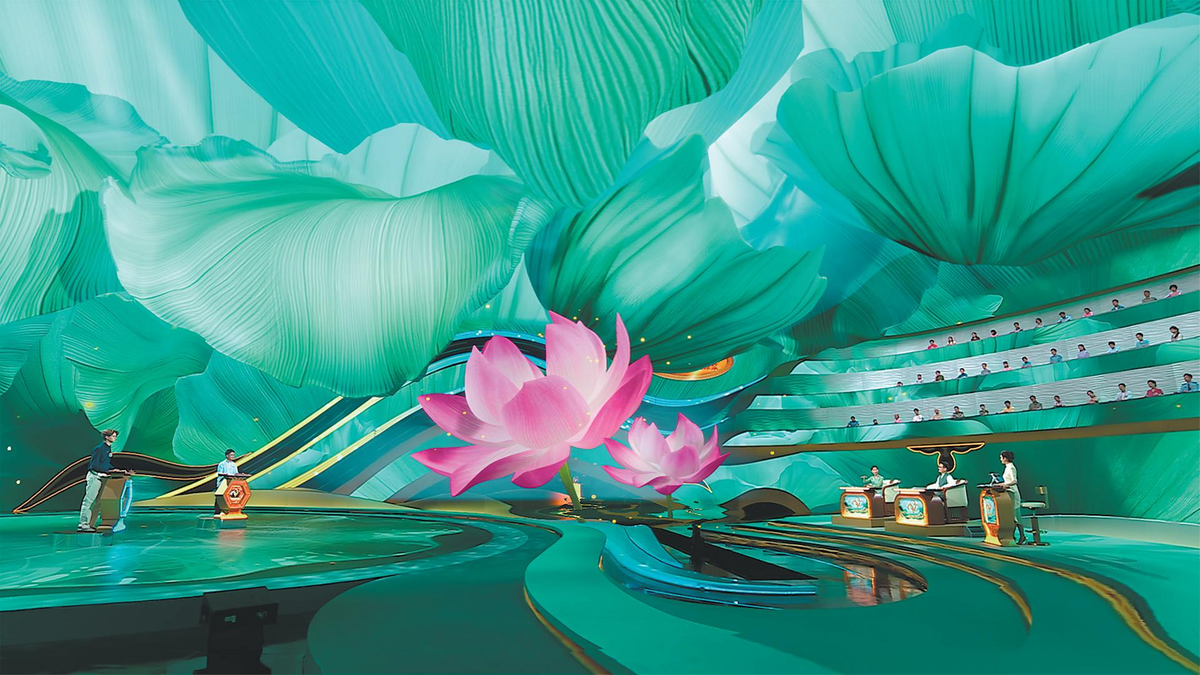
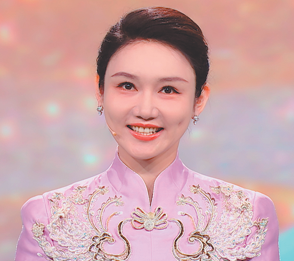
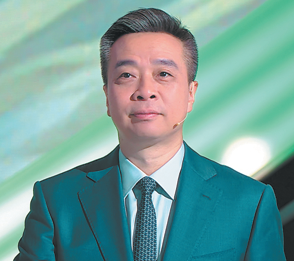
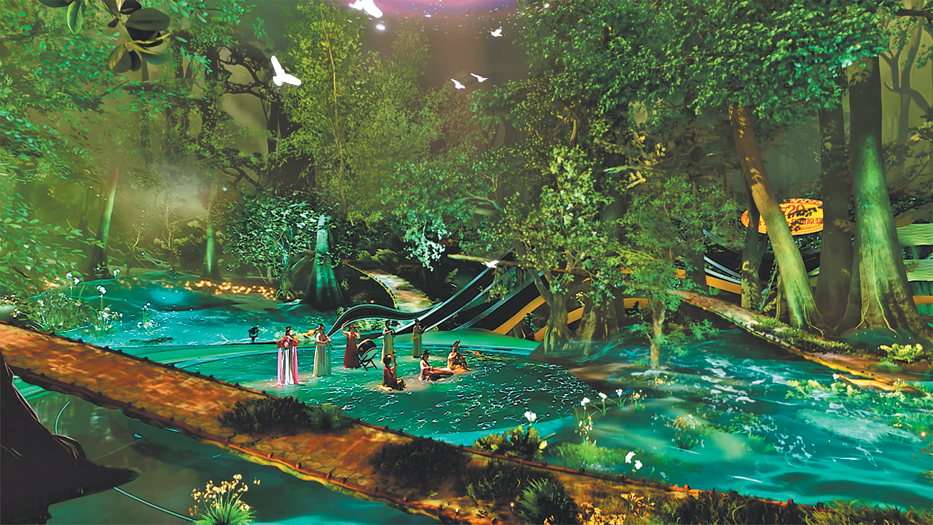
Technology has further reshaped how poetry connects with audiences. Yan Fang, producer and chief director of Chinese Poetry Conference, says this season uses innovative lighting effects and advanced rendering algorithms to create virtual cinematic spaces, with light, air and imagery conveying a vivid sense of movement and life.
On stage, surging waves and a soaring dragon form a striking centerpiece. The dragon's translucent, flowing body is animated using fluid dynamics algorithms, while its skeletal structure, textures and lighting are generated in real time through physical calculations, resulting in seamless, dynamic visuals.
This season also marks the program's first use of AI-generated dynamic human figures. To re-create the bustling night markets of Chang'an (today's Xi'an, Shaanxi province) at its peak, the production team built expansive scenes and populated them with vividly rendered crowds.
Yan notes that dynamic character creation requires complex models and immense computing power. After extensive testing, the team combined AI-generated imagery with a custom compositing method, allowing lifelike Chang'an residents to move naturally through the night markets and immerse audiences in a festive atmosphere.
The program also draws on classic imagery to evoke collective memory. With 2025 marking Chinese cinema's 120th anniversary, the show re-creates an open-air movie scene familiar to those born in the 1970s, with neighbors gathered in courtyards, projectors humming, ice pops and watermelon, and palm fans stirring the summer air, gently transporting viewers back to childhood.
As the audiovisual industry shifts from television-led programming to short-form content, Chinese Poetry Conference continues to exhibit vitality.
Yan attributes this longevity to two factors: steady yet flexible content innovation that balances knowledge and entertainment, and a deliberate decision to "slow down" through in-depth interpretation, allowing audiences to fully experience the rhythm, beauty and cultural depth of poetry, and to build lasting trust in a shared culture.
Liao Xiangzhong, Party secretary of the Communication University of China, describes Chinese Poetry Conference as a benchmark for media-enabled dissemination of traditional culture.
"By integrating virtual environments and AI technologies, the program transforms poetic imagery into immersive, participatory audiovisual experiences, vividly demonstrating the creative transformation and innovative development of China's traditional culture in the new era," Liao says.
Li Guoqiang, vice-president of History Research of China, believes poetry preserves the imprint of history, with each line carrying the breath of its time.
"From frontier poems expressing aspirations of border defense to pastoral poems reflecting people's livelihoods, poetry is interpreted within concrete historical contexts, tracing the emotional and spiritual evolution of Chinese civilization.
"The program not only presents poetic beauty, but also reveals institutional change, social life, and collective mentality through expert interpretation and contextual reconstruction, guiding audiences on a humanistic journey across time," Li adds.
To extend this journey beyond the screen, the program has gradually transformed poetic imagination into a tangible cultural experience, encouraging audiences to seek out the landscapes and histories embedded in verse.
On-location segments further connect poetry with travel. In Bijie, Guizhou province, drone footage of mountainsides ablaze with flowers vividly echoes the line of Ming Dynasty (1368-1644) poet Wang Shizhen: "Spring winds open flowers across ten thousand mountains; winding streams and crumbling cliffs reflect multicolored clouds."
Such scenes have inspired audiences to visit these landscapes. Leveraging the reach of Chinese Poetry Conference, locations celebrated in classical poetry have become popular destinations, prompting cultural and tourism authorities to develop integrated "poetry + tourism" initiatives.
Fengjie county in Chongqing, located in the Three Gorges Reservoir area, is home to landmarks such as Baidi City, Qutang Gorge and Kuimen Gate. Tang Dynasty (618-907) poets Li Bai and Du Fu once traveled there, leaving behind enduring works. In recent years, Fengjie has actively explored new models integrating poetry and tourism.
Fengjie's connection with Chinese Poetry Conference dates back to 2017. The program offered the county a national platform to showcase its cultural depth and, in turn, it presented its natural beauty, cultural richness, and development to audiences nationwide.
Tian Li, a Fengjie-born contestant in the 2024 edition, says growing up in a poetry-rich environment made the love for poetry feel natural. Verses projected by streetlights often draw passersby to pause and read.
"Poetry has enriched my inner world, and the philosophy embedded in poetry also guides my life's direction," Tian says.
Beyond Fengjie, places such as Yuanling county in Huaihua, Hunan province, and Luojiang district in Deyang, Sichuan province, have also integrated poetry into cultural tourism.
Through poetry festivals and related initiatives, they promote contemporary interpretations of classical verse, using natural scenery and cultural depth to connect past and present, allowing poetry to resonate anew in the modern era.



Today's Top News
- Chinese market vast ocean for Finnish and other European firms to swim in
- UK PM Keir Starmer will pay official visit to China
- Xi says China ready to uphold UN-centered intl system with Finland
- Journalists invited to cover the 2026 two sessions
- Xi meets Finnish PM in Beijing
- China, OIC vow to deepen partnership