


Consensus, not coercion, key to Ukraine crisis










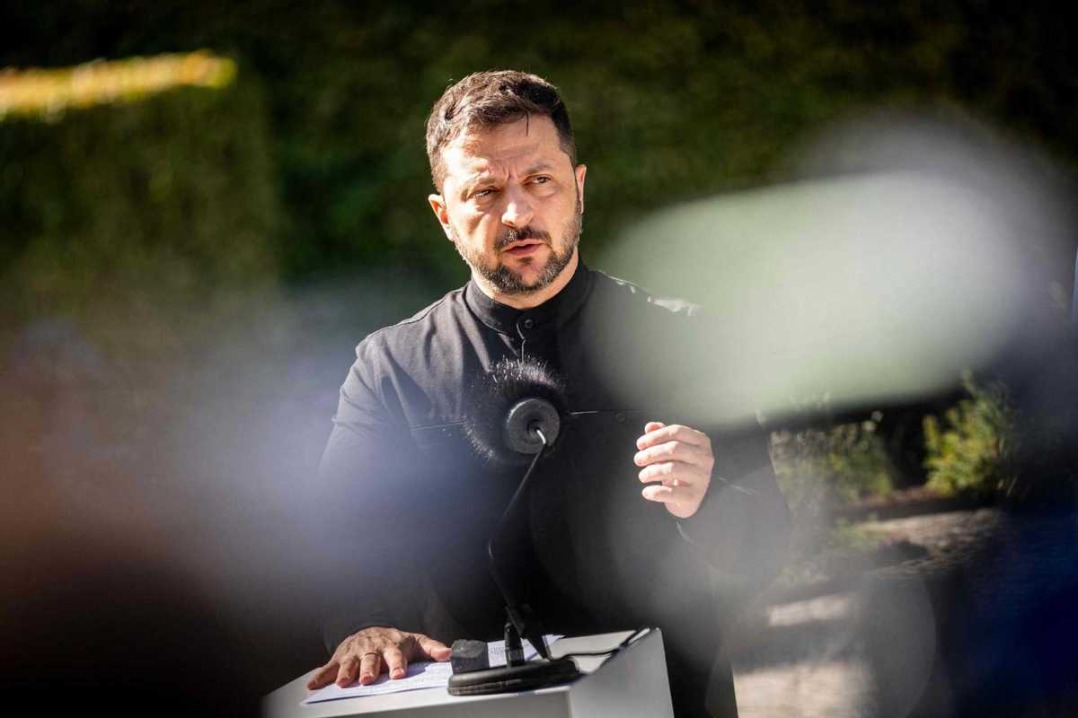
After nearly four years, the Russia-Ukraine conflict is moving from a prolonged military stalemate to a far more intricate political phase. The United States' 28-point peace plan has led to intensive diplomatic consultations. Following meetings of Ukrainian President Volodymyr Zelensky with leaders of major European countries, Kyiv has adjusted its approach recasting the US plan into a 20-point framework agreement, a transatlantic security guarantee document and a postwar reconstruction plan for Ukraine. These developments indicate that the peace process has reached a critical juncture.
It is now widely acknowledged that military means cannot resolve the differences between the two sides. Lasting peace will require rationality, restraint and sincerity from the conflicting parties, and an objective and fair approach from relevant stakeholders. Consensus can be built only through equal consultations, not coercion and the peace agenda can be advanced only if all sides act in good faith.
Ukraine today is grappling with internal and external pressures, and facing the most challenging conditions since the conflict began. A key reason is Washington's "burden-shifting policy", which has sharply reduced military aid to Kyiv. Although Europe has tried to fill the gap left by the US, it is still insufficient, leading to heightened battlefield pressure for Ukraine.
At the same time, corruption cases involving senior Ukrainian officials have sparked protests and political turmoil, forcing Kyiv to reshuffle its negotiation team. Although the Ukrainian government has relaxed age limits for military conscription, domestic mobilization is strained, and the manpower gap compared to Russia continues to widen. Against this backdrop, Ukraine's disadvantage on the battlefield has increased, with its territorial losses more pronounced compared to 2024. If Western aid to Ukraine continues to decline, Kyiv will lose more leverage, both on the battlefield and at the negotiating table.
Meanwhile, political gaming remains intense. Washington is pushing to freeze the conflict, increasing pressure on Ukraine to make concessions. While Europe and Ukraine have proposed a revised plan, it diverges from the proposals of both Washington and Moscow. That leaves Ukraine in a relatively weak position in the negotiations.
Under US pressure, Ukraine's stance has notably shifted from the 10-point peace plan proposed by Zelensky in 2022. It no longer emphasizes reclaiming all occupied territories. Moreover, it has agreed to conditionally hold presidential elections, accept reasonable limits on its post-conflict military size and explore the possibility of mutual and equidistant disengagement in the Donetsk region.
The prolonged deadlock stems from the deep and irreconcilable differences over core issues such as territorial sovereignty and security concerns. External powers, particularly the US and Europe, have largely treated Ukraine as a strategic lever to advance their own interests. Rather than facilitate reconciliation, their actions have only exacerbated the antagonism.
On multiple occasions, the priorities of external players have taken precedence over Ukraine's sovereignty, territorial integrity and long-term development prospects. Under the weight of competing interests, cracks have appeared in what was once a unified alliance.
The US policy toward Ukraine has also prioritized economic gains, which is evident in Washington's threats to suspend critical military support to pressure Kyiv into signing mineral resource agreements. Additionally, the US has proposed using frozen Russian assets to generate returns, advocated for the withdrawal of Ukrainian forces from the Donetsk region to establish an economic cooperation zone in the vacated areas, and initiated discussions on managing Ukrainian assets after the conflict ends.
As the conflict drags on, differences between the US, Europe and Ukraine, as well as within the transatlantic alliance, have become increasingly pronounced. The Joe Biden administration had maneuvered to lock both sides into a war of attrition. In contrast, the US administration explicitly rejected Ukraine's entry into NATO, once the major incentive for Kyiv's wartime stance.
Europe, meanwhile, seeks to maintain US security commitments while trying to turn Ukraine into a "steel porcupine" to guard the continent. But despite supportive voices for Ukraine, practical constraints such as defense industrial capacity, fiscal pressures and internal policy differences have made it challenging for Europe to independently bear the long-term costs and risks of providing security guarantees to Ukraine. European initiatives thus remain conditional on US support.
The spillover effects of the crisis have disrupted the global energy and food markets, impeding world economic recovery and inflicting profound suffering on both Russia and Ukraine. The evolving geopolitical landscape and the trajectory of the conflict prove that a zero-sum mentality is not a sustainable resolution. Security is mutual and indivisible. The security of one country should not come at the expense of another. This is a core tenet of China's vision of a common, comprehensive, cooperative and sustainable security.
Peace that fails to address the root causes of conflict will always be fragile. There is no ready-made formula for achieving lasting peace between Russia and Ukraine. Relevant parties should uphold fairness and justice, and work together to reach a fair, reasonable and binding peace agreement that provides much-needed certainty for regional and global stability.
The author is a researcher at the Institute of Russian, Central Asian and East European Studies, Chinese Academy of Social Sciences.
The views don't necessarily represent those of China Daily.
If you have a specific expertise, or would like to share your thought about our stories, then send us your writings at opinion@chinadaily.com.cn, and comment@chinadaily.com.cn.