


Indonesian doctors train in Gansu









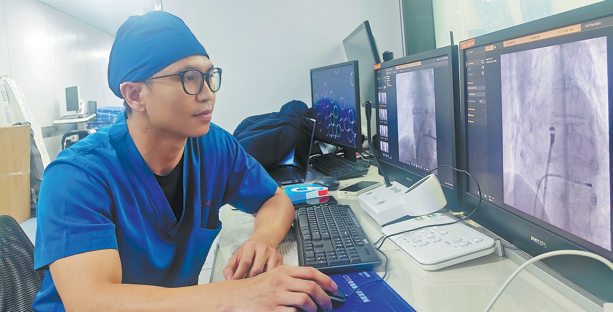
Nine Indonesian doctors are undergoing a one-year advanced training program in interventional cardiology at a hospital in Gansu province under a medical cooperation program between the Chinese and Indonesian health authorities.
The clinical fellows are based at the Lanzhou University First Hospital, where they are taking part in an intensive, hands-on training designed to help address a shortage of specialized cardiovascular expertise in Indonesia.
Bai Ming, vice-president of the hospital, said the program was launched to help train Indonesian cardiovascular doctors, as interventional cardiology remains in an early stage of development in the Southeast Asian nation.
Trainees are expected to assist or independently complete at least 300 procedures before qualifying for graduation. On average, however, each trainee will participate in 400 to 500 interventional procedures during the program, Bai said.
The hospital's cardiothoracic catheterization laboratory performs around 23,000 procedures annually, including 6,000 to 7,000 coronary interventions, providing the Indonesian doctors with abundant clinical cases for training. "Every year, we receive about 1,000 patients with acute myocardial infarction, so the Indonesian fellows have ample opportunities to learn and develop expertise," Bai added.
During their stay in Lanzhou, the trainees will receive systematic guidance from senior mentors through a combination of classroom teaching and clinical practice, enabling them to master key diagnostic and therapeutic techniques in cardiovascular interventional care.
"I have gained valuable experience here, especially in coronary angiography and angioplasty," said Muhammad Insani Ilman, who came to China in March. "We have seen many advanced medical technologies, such as ultrasound-based instruments, which are not yet widely available in Indonesia. We hope to learn from China, share these technologies, and apply them back home to benefit more patients."
Juang Zebua, another participant in the program, said China's strong medical education system and extensive clinical resources were the main reasons he chose to study in Lanzhou. "Most of us have heard that China is very strong in education and technology, and the Chinese people are very warm," he said."That's why we chose to come here."
"The workload is heavy, but every patient brings new experience and knowledge. The doctors and nurses here treat us like family," Juang added.
"We treat the Indonesian doctors as our own colleagues," said Gu Zhicong, head nurse of the catheter lab, who also makes the Indonesian fellows' daily living and work arrangements. "They are scheduled for regular and night shifts, participate in emergency cases, and are fully involved in our daily clinical work. They are part of our big family, and even their Chinese names were given by our team."
Apart from work, the fellows have visited Dunhuang and other places of interest in Gansu. "They are interested in Chinese culture, and I think this is a good way to enhance cultural and people-to-people exchanges between our two countries," Bai said.
"Living in Lanzhou has been a wonderful experience for us. This exchange program between China and Indonesia is a very valuable opportunity," Ilman said. "We hope this cooperation will continue so that we can build a better future together."
Over the years, Lanzhou University First Hospital has continued to build an international medical exchange platform, and has provided training for many cardiovascular specialists from countries involved in the Belt and Road Initiative.
"The exchange benefits both sides," Bai said. "It helps improve clinical skills, education and research in cardiovascular interventional care, while also enhancing our hospital's international influence."
Contact the writers at huyumeng@chinadaily.com.cn