



Elderly patients gain accessible cognitive care at memory clinics









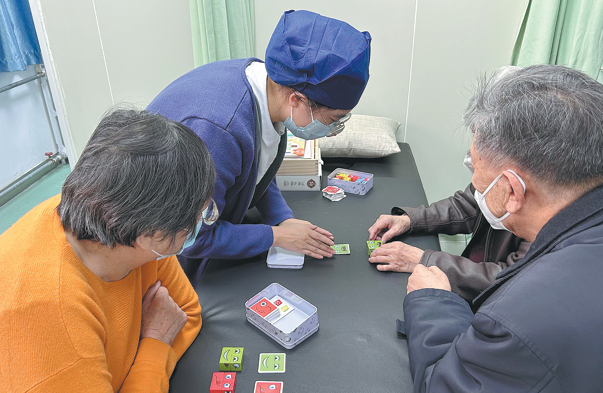
Every Wednesday morning, an 88-year-old woman slowly walks into a memory clinic at a community health center in Beijing, accompanied by her husband.
She greets the doctor, sits down at a small table, and begins working on a jigsaw puzzle designed for a 6-year-old child, fitting the pieces together one by one under the medical personnel's guidance.
The weekly ritual is part of her cognitive training. Diagnosed with Alzheimer's disease in 2022, she now struggles with memory loss and speaks little to those around her.
There was a time when each medical visit meant an hour-long journey across the city to a top-tier hospital, adding physical and emotional strain to an already difficult routine.
Since last year, however, her rehabilitation and regular checkups have taken place just a few steps from home, at Hepingli Community Health Service Center.
"It's so convenient not having to travel far to see a doctor," she said.
This shift reflects a broader move towards community-based care for patients with cognitive impairment in Chinese cities.
By the end of 2024, China's population aged 60 and above had reached 310 million, accounting for over one-fifth of the total population. Of this demographic, more than 53 million people suffer from cognitive impairment, a number that grows as the country's aging population increases.
Cognitive impairment refers to a set of symptoms caused by brain disorders that affect memory, language and reasoning. Dementia is a severe form of cognitive impairment, and Alzheimer's disease is the most common cause of cognitive impairment.
Han Ying, neurologist at Xuanwu Hospital of Capital Medical University in Beijing, explains that while Alzheimer's disease cannot yet be cured, early diagnosis and intervention are crucial in treating it. Regular cognitive training and medication under a doctor's guidance are effective ways to slow the progression of the condition.
"Although symptoms cannot be reversed, early detection and intervention, before obvious symptoms appear, can delay their onset by up to five years, giving patients the chance to maintain normal or near-normal cognitive function for the rest of their lives," she said.
However, due to the stigma of illness and the misconception that early symptoms are part of natural aging, only around one in five dementia patients in China ever receive a formal diagnosis, Han said.
In addition, for seniors living far from top hospitals, frequent travel for rehabilitation can be a major hurdle.
Community memory clinics have emerged as a solution. Beijing opened its first such clinic at Hepingli Community Health Service Center in 2023.
Li Jianguo, the center's deputy director, said that each year the center offers free health check-ups for senior residents. Those suspected of cognitive impairment undergo an initial assessment and, if needed, are referred to top hospitals for further evaluation.
The center's memory clinic also provides access to expert care. Every Wednesday, doctors from leading hospitals hold consultations there, serving about 10 patients. Notably, rehabilitation services are available daily and are supported by nurses, Li said.
Today, the memory clinic has become a hub for both rehabilitation and social interaction. In the clinic, some seniors could be seen tapping away at "whack-a-mole" computer games, while some were reading prose aloud accompanied by the doctors.
Nearly every week, the clinic hosts a group activity when about 10 seniors gather to make collages, and it also offers options like puzzles, dominoes, and toy fishing games.
An 86-year-old woman surnamed Feng eagerly participates in every group activity. With her children away, a caregiver accompanies her. "I love chatting with everyone, it's so lively. It makes me feel young again," she said.
"Active participation in intellectual and social activities helps slow further brain decline," said Zhu Jie, a doctor at the memory clinic.
Currently, nearly 100 seniors with cognitive impairment are registered in the health records at this center.
Beijing now has more than 20 community memory clinics, with plans to grow this number to 100 by 2030. Other regions, including East China's Shanghai and South China's Guangdong province, have also opened community memory clinics, and some private hospitals have followed suit.
Sunbow Obstetrics and Gynecology Hospital, located in Beijing, launched its memory clinic in early January, offering a full cycle of early screening, diagnosis, intervention and long-term follow-up services.
"We want to prevent patients from reaching severe dementia," said Jiang Tao, the hospital's marketing director. "Memory clinics not only improve life quality for those with obvious symptoms but also help early-stage patients slow progression. They serve as warm havens for safeguarding memory."
At present, specialized outpatient services for cognitive disorders remain concentrated in hospitals, and community-based memory clinics are mainly located in major cities such as Beijing, Shanghai and Guangzhou. Grassroots memory clinics are still scarce in other regions, especially rural areas, said Li.
In rural healthcare institutions, he noted, limited employee capacity, equipment and medicine shortages, and weak support from higher-level hospitals mean that establishing grassroots memory clinics will take considerable time.
Still, he believes that whether in cities or the countryside, raising public awareness of cognitive health must come first. "Greater attention from society as a whole is essential," he said.
The Chinese government issued an action plan regarding elderly dementia in 2024, aiming for over 50 percent of people suspected of cognitive impairment to have sought medical care by 2030.
Hepingli Community Health Service Center holds monthly lectures for local residents.
"We hope that through continuous efforts, we can awaken awareness among both the elderly and society at large, thereby helping more seniors to hold on to their memories for as long as possible," said Li.
Xinhua





Today's Top News
- Wake-up call for Europe to review its dependency: China Daily editorial
- China reports 5% GDP growth in 2025
- Return capsule of Shenzhou XX safely returns to Earth
- Sanya rises as magnet for Russian tourists
- China's steady opening-up for Asia-Pacific economic growth
- Blueprint seen as a boon for entire world