



Panda pair getting used to new home in Moscow









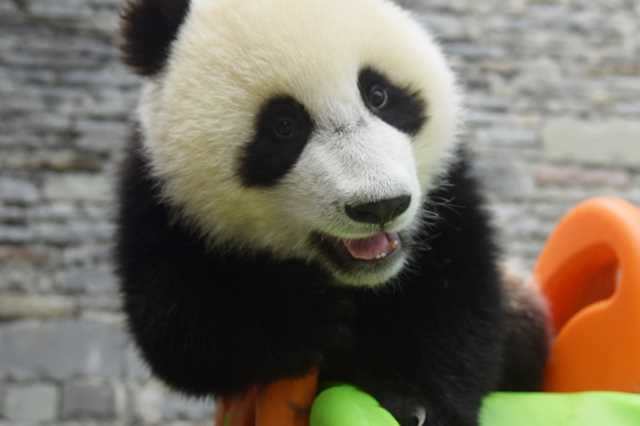
"Her behavior showed she has a wild nature. She was born to parents who were both wild," Li said.
The two pandas had lived at Dujiangyan base in Sichuan before the quarantine. Li began attending to them after their arrival at Ya'an.
"Ruyi adapted to the new environment at Ya'an quickly. But it took a week for Dingding to finally feel at home," he said.
Xiong Yaowu, head of the Ya'an base, said Russia attached great importance to the pandas.
Two delegations of Russian vets and keepers arrived at the base during the two pandas' quarantine.
Each delegation of keepers stayed for more than 10 days, feeding them bamboo and apples and learning how to disinfect the dens and vaccinate them.
"That is because a certain antibody may disappear over a period of time, and vets must vaccinate them again," Li said.
Visiting the dens of Ruyi and Dingding with his girlfriend on Friday, Andrey Ardeev, 40, from Siberia, said he loved pandas, which are more docile than the brown bears in his homeland.
Ardeev said the Russian people were looking forward to visiting the two pandas at the Moscow Zoo.
The zoo has completed its preparations to host the pandas from China, said general director Svetlana Akulova.
This is the second time that Russia has received pandas from China. In 1957, two from Baoxing, a county under the administration of Ya'an, arrived at Moscow Zoo.





- China's Global Governance Initiative receives positive feedback at forum
- China's Xizang sees steady tourism growth in 2025
- First-of-its-kind pearl auction held utilizing Hainan FTP
- Agarwood exhibition steeps Shanghai museum in fragrance
- The Fujian Coast Guard conducts regular law enforcement patrol in the waters near Jinmen
- IP protection for new fields to improve