



Scientists find bird foot in dinosaur-era amber









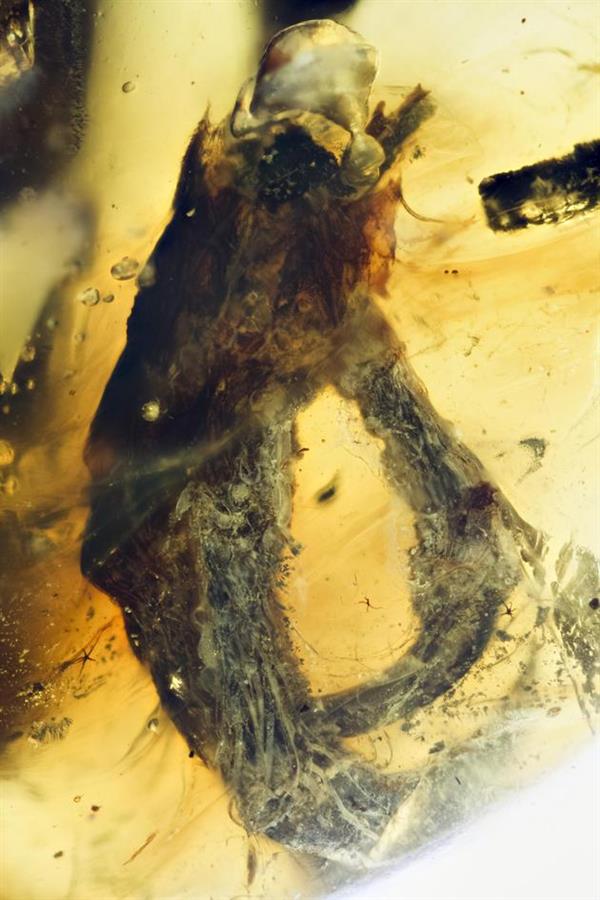
BEIJING -- A team of Chinese, American and Canadian researchers have discovered amber containing a bird foot dating back around 100 million years.
The specimen was excavated at Hukawng Valley in northern Myanmar, an area rich in amber fossil discoveries. The result of the research was published by Scientific Reports on Wednesday.
"The bird foot is less than 7 millimeters long and well-preserved," said Bai Ming from the Institute of Zoology under the Chinese Academy of Sciences, co-author of the paper.
"This allows the researchers to build a high-definition three-dimensional model of the foot through computed tomography (CT)," Bai said.
The researchers found ragged fractures on the model, suggesting the bird foot was already broken before it was encased in resin which later formed into amber, according to Xing Lida, a leading scientist of the study from the China University of Geosciences in Beijing.
"The foot was probably left by predators or scavengers," Xing said.





- China's Global Governance Initiative receives positive feedback at forum
- China's Xizang sees steady tourism growth in 2025
- First-of-its-kind pearl auction held utilizing Hainan FTP
- Agarwood exhibition steeps Shanghai museum in fragrance
- The Fujian Coast Guard conducts regular law enforcement patrol in the waters near Jinmen
- IP protection for new fields to improve














