
In one of his most celebrated prose poems Qian Chibi Fu (First Ode to the Red Cliffs), 11th-century literary giant Su Shi wrote, "A clear breeze blows gently, not causing ripples on the water." The tranquil scene evokes a serene mood in nature and, metaphorically, reveals the poet's inner calm while living in exile, poised between hardship and philosophical acceptance.
At an ongoing exhibition at the National Art Museum of China in Beijing, the image of the breeze is borrowed to symbolize the unpretentious, understated beauty of the Chinese ink art tradition, gently ushering viewers into a state of meditative stillness.
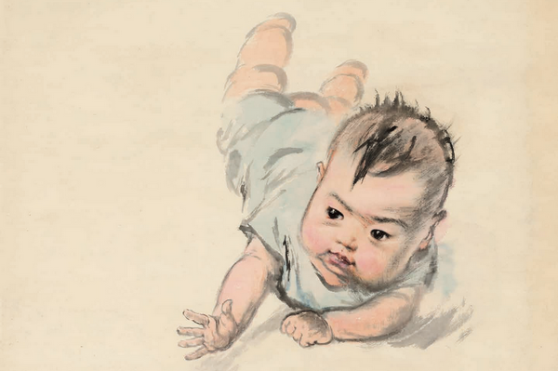
Running until Saturday, the exhibition Breeze from the Centennial Lake Club zooms in on the creations of artists active in Beijing and Tianjin in the first half of the 20th century to give an expansive view of culture and society in the area.
Nearly 200 works by more than 100 artists are on display, many of whom belonged to influential art groups and associations of the time. Among them is the Lake Club, or Hu She, after which the exhibition is named. Founded in Beijing, the group later expanded to other cities, with its Tianjin branch emerging as the most influential.
Although the exhibition highlights artists in Beijing and Tianjin, often referred to collectively as the Jingjin School, it underscores a broader historical moment marked by dramatic change and creative innovation from the late 19th to the early 20th centuries. This was a pivotal period when artists recognized the urgency of reforming Chinese painting, freeing it from rigid conventions so it could respond to evolving aesthetic sensibilities.
Major art schools emerged in cities to initiate progressive movements through the rediscovery of the past. For example, artists revisited the reformist spirit of the Song (960-1279) and Yuan (1271-1368) dynasties, when painters had similarly challenged orthodoxies in pursuit of expressive renewal.
There were primarily the Shanghai School (Haipai), the Lingnan School in Guangzhou, Guangdong province, and surrounding areas, and the Jingjin School.
What energized the Jingjin School were societies like the Lake Club. Some were loosely organized, while others held regular activities and exhibitions. Together, they sought to reinvigorate ink painting as the quintessence of Chinese cultural tradition, while selectively absorbing foreign influences, including clearer figurative structures and richer approaches to color.
Many leading figures who championed the Jingjin School were from the reputed Research Society for Chinese Painting.

"Members of the research society addressed the needs of their time by reviving Song Dynasty aesthetics, and drawing inspiration from Western techniques, notably through studying the works of Giuseppe Castiglione (1688-1766), the Italian missionary serving as a court painter of the Qing Dynasty (1644-1911)," says veteran theorist Xue Yongnian.
Xue, a professor at the Central Academy of Fine Arts, says these artists promoted individual expression, embraced the cultural needs of urban residents, and studied ancient stone carvings and sculptures. "These collective efforts contributed to the remarkable rise of great artists like Qi Baishi (1864-1957) who both honored tradition and pioneered 20th-century Chinese art."
Pan Yikui, director of the National Art Museum of China, says many figures in the Jingjin art circle studied or traveled overseas to broaden their horizons. "Having seen the vastness of the world, they nonetheless retained a genuine appreciation for their own culture, and continued to express the Chinese interpretation of nature and the inner self."
Some works on display are from a recent donation to the National Art Museum of China by Xu Xianfeng, a collector devoted to artists of the Jingjin School.