



Nation's underwater archeology uncovered
The passionate people behind China's search for submerged treasure trove of rich maritime relics









Time capsules
Each ship carries a tale from procurement and loading to sailing and, ultimately, sinking.
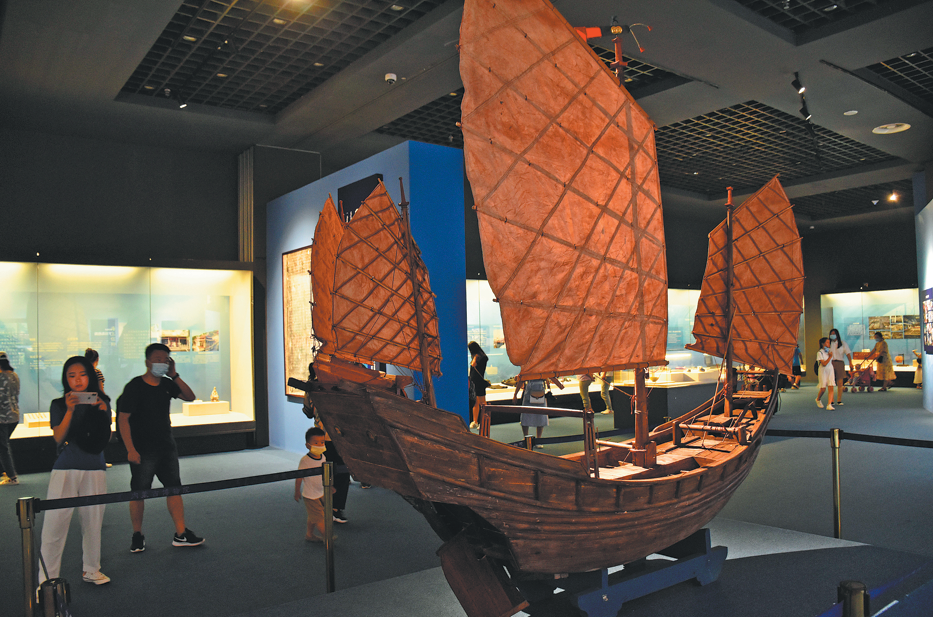
The 2024 documentary, The Sinking of the Lisbon Maru, unveiled a previously unknown chapter of history, while ancient shipwrecks like the Nanhai One narrate the life and times of the Maritime Silk Road — one of the oldest known sea routes linking East and West.
Originating in the Han Dynasty (206 BC-AD 220), the Maritime Silk Road became a primary avenue for ancient China's foreign trade, comprising eastward and westward routes, with the former reaching Korea and Japan, the latter stretching to Southeast Asia, West Asia and Africa.
"When it comes to the Maritime Silk Road, people often only know the starting and ending points, the sales channels and the origins of goods. But, the route itself, mediated by the sea, is the most challenging to find," Cui said, using Nanhai One as a "time capsule" and point for retracing the ancient maritime path.
"Each shipwreck is a dot. The more you find, the more connected they become, forming a line that reveals the route," he said.
As these time capsules on the seabed are unlocked, they reveal the bustling maritime-terrestrial trade of centuries past.
"We must honor those ancestors who left us this tragic yet invaluable (insight into our) cultural heritage," Cui told students at the underwater archaeology training base in Pingtan.
Spanning over three decades, Cui's career has paralleled Nanhai One's rediscovery and excavation. His enduring patience and resilience are the hallmarks of an archaeologist's success. "One day at a time and, before you know it, you've lived through history," he said.
Cui has witnessed the development of China's underwater archaeology, from in-situ excavation to cofferdam extraction and mastering deep-sea archaeology projects.
Like the aged boat in the training center's courtyard, its body tells stories of storms and years gone by. Its original shape might be hard to recognize, but its presence encourages everyone to remember the journey taken and to understand the way forward.
Centuries ago, a Southern Song Dynasty merchant ship set off on the vast journey of the Maritime Silk Road and left behind a trail of historical embers across the ocean floor.
Today, China's Belt and Road Initiative is building a solid bond of trade and human connection, as fragments of history are salvaged from the ocean depths, not just reconstructing the past but reflecting the confidence and vision of a nation venturing into the deep blue.


- Video captures Guizhou's transition from winter to spring
- Chinese scientists refine lunar global chemistry mapping using farside ground truth information
- Wuxi High-Tech Zone launches supportive policies for OpenClaw project
- Prosecutors in action: Innovation thrives when rights are protected
- China's five-year roadmap bets big on innovation in strategic leap
- Remains of senior Chinese official Song Ping cremated





