



China launches new space science program









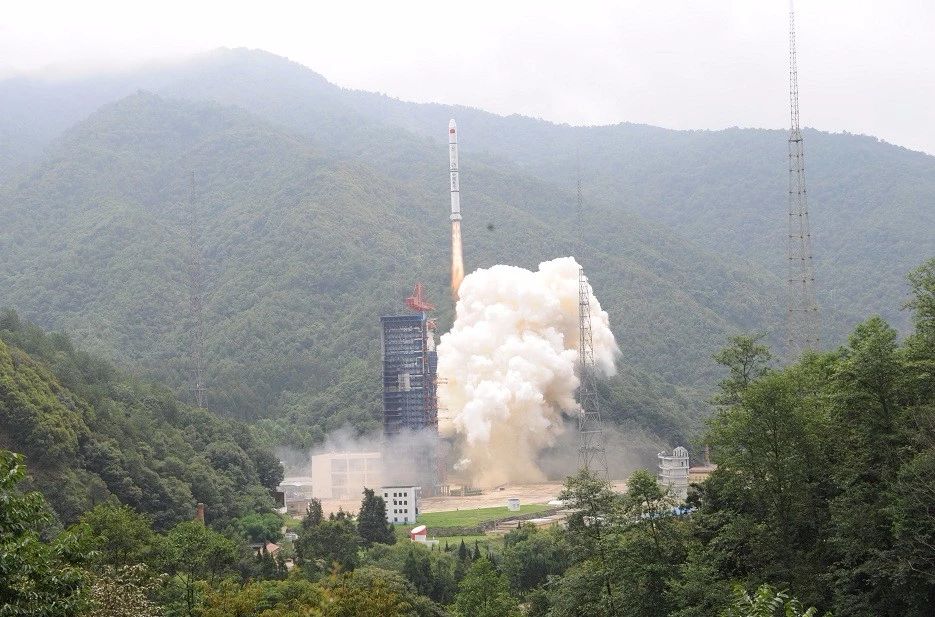
BEIJING -- China Wednesday launched a new space science program focusing on the origin and evolution of the universe, black holes, gravitational waves and relationship between the solar system and human.
The Chinese Academy of Sciences (CAS) announced to develop a group of four satellites in the program.
The program includes a satellite named "Einstein-Probe (EP)", which is tasked with discovering celestial bodies that emit X-rays during fierce changes as well as quiescent black holes with transient high-energy radiation.
The Advanced Space-borne Solar Observatory (ASO-S) will help scientists understand the causality among solar magnetic fields, flares and coronal mass ejections.
The Solar wind Magnetosphere Ionosphere Link Explorer, or SMILE, which is a Sino-European joint mission, will focus on the interaction between the solar wind and the Earth magnetosphere.
The program also includes the Gravitational Wave Electromagnetic Counterpart All-sky Monitor (GECAM), which is aimed at searching for electromagnetic signals associated with gravitational waves.
The program is expected to attract the outstanding scientists and engineers in China to achieve scientific breakthroughs and technological innovation, said Wang Chi, director of the National Space Science Center under CAS.
Over the past few years, China has launched a series of space science satellites, including the Dark Matter Particle Explorer (DAMPE),the Quantum Experiments at Space Scale (QUESS) and the Hard X-ray Modulation Telescope (HXMT).





- China sends task force after deadly explosion in Inner Mongolia
- China's grain and livestock output rise in 2025
- Cold wave sweeps China, forcing school closures and snow response
- Guangzhou hospitals expand use of cell, gene therapies
- State Council to supervise probe into factory explosion in North China's Inner Mongolia
- Chinese courts see surge in foreign-related cases