



Herders welcome changes in Xinjiang's 'Valley of Life'









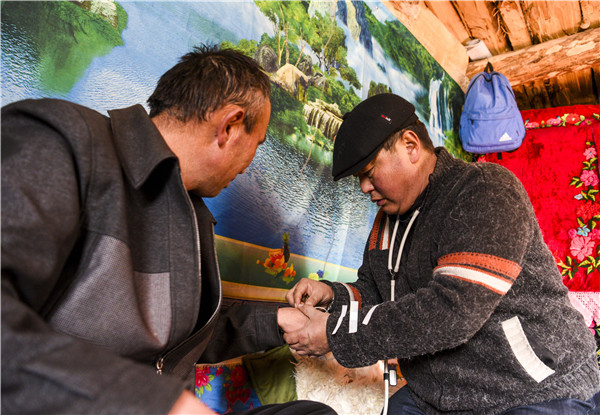
The doctors even treat animals.
Gyens has witnessed many changes over the years: Roads have been widened; cellphone towers have been built; solar panels have been installed so that herders no longer need to use kerosene lamps or candles for light; people have also set up satellite receivers to watch TV; and motorcycles are replacing horses. "When spring comes, construction of the new hospital building will be complete," Gyens said.
Business has also taken root. The only shop nearby is owned by Baktikeld Bagaturbay, who has turned his little cabin into a trading center. He sells beer, instant noodles and snacks, simple but sufficient to fill the stomachs of hungry herders.
"I started my business with a loan. Then my business expanded thanks to my wife's cooking. Now I can earn 4,000 to 5,000 yuan ($630 to $790) every winter," he said.
Bagaturbay is not only the most successful businessman in the valley, but also the proudest father. As a top student, his daughter Aydala has been admitted to a program in Guangdong province for students from Xinjiang to study in more economically developed regions.
About 5,000 km from home, Aydala has inspired the children in the valley.
"When I grow up," Yeyeni, 14, told his father Nurkaldi, "I want to work in a big city."


- Manas in Xinjiang steps up improvement of sheep breeding
- Chinese scientists enable more realistic digital humans by building high-precision 3D facial database
- China to enhance childbirth support
- China's top legislature reviews draft law on national development planning
- People-oriented service for grassroots impact
- What they say





